



How to Turn Public Consultation Feedback Into Clearer Reports for Stakeholders
Topics
Public consultation reporting is often the hidden hurdle in the built environment and construction sectors. While the engagement phase is high-energy, the aftermath is frequently slow and manual. By the time a consultation closes, teams are often left "data-rich but insight-poor," wading through a significant volume of feedback, map responses, and recurring objections.
Turning response data into reports that teams can use for internal design, clients, planning committees, or planning applications shouldn't be a bottleneck, but often in many teams it is.
PlaceChangers consultation tools and planning software bridges this gap, allowing design teams to synthesise data in the background from the moment the first response is submitted in clean, consistent ways, structured and aligned to project requirements.
1. Clear Public consultation reporting Starts at the Point of Collection
One of the main reasons public consultation reporting takes weeks is that feedback often arrives in "messy" formats — unstructured emails, PDFs, and unformatted spreadsheets. If the data is messy at the start, the report will be difficult to produce at the end.
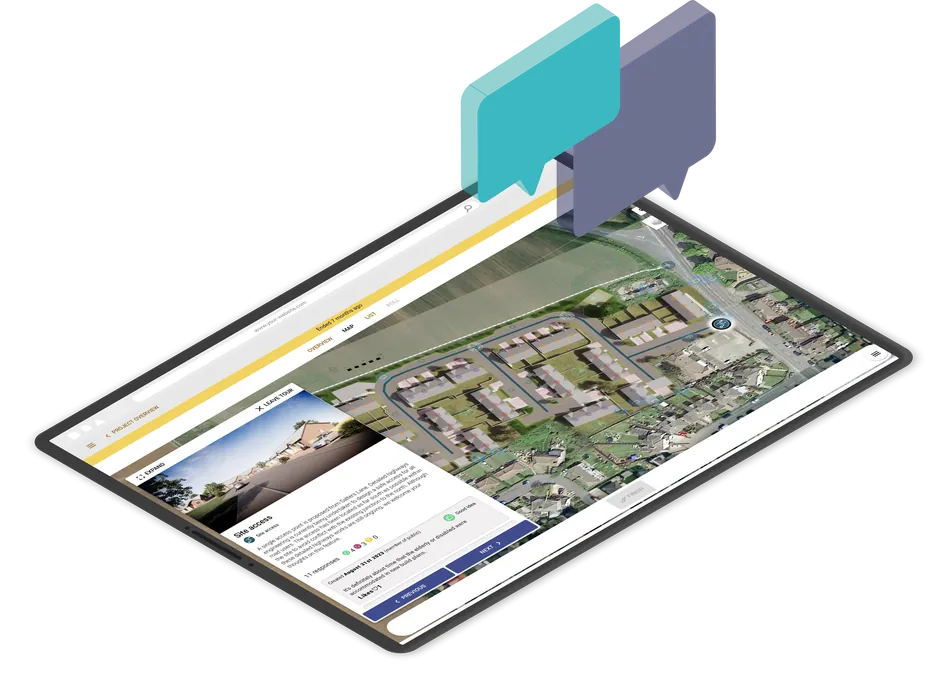
PlaceChangers solves this by structuring feedback at the point of entry. Our platform supports both general consultation answers and location-specific mapped feedback in the same response estate. While some consultations are naturally questionnaire-led, the strongest evidence for specific, helpful reporting sits on the "mapped" side of the platform.
By using interactive consultation maps and guided response options, design teams ensure feedback is categorised from day one. Instead of one undifferentiated block of text, your team can instantly view data filtered by:
- Location-specific features: Link comments directly to site elements.
- Thematic sentiment: Distinguish between general support and specific objections.
- Demographic trends: Automate the diversity reporting required for a Statement of Community Involvement (SCI).
2. Spatial Precision: Evidence from Recent Construction Consultations
In masterplanning and construction, location is context. Traditional reports often lose this; a comment like "This entrance feels unsafe" loses its impact when stripped from its geographic position. Preserving spatial context helps with the pre-application community consultation process, as it allows developers to address site-specific concerns before they escalate."
PlaceChangers' interactive consultations tool preserve that spatial context, making mapped responses materially more specific than general questionnaire comments. We looked at 10 recent construction consultations, covering a mix of 4 strategic outline schemes and 6 detailed applications of varying size between 20 to 300 homes.
The Evidence: Live PlaceChangers data suggests the platform captures a materially more structured response set than standard formats. In this sample:
- 100% of mapped responses already carried spatial or thematic context.
- 86% carried proposal-theme context from the outset.
- 43.9% already had sentiment attached.
- 35.4% already had a specific response category assigned.
- 34.1% were tied to a specific named location.
Pro-Tip for Consultants: For a significant portion of your data, the "analysis" is finished before you even open the dashboard. This removes the "Step Zero" of data cleaning, allowing you to move straight to strategic interpretation. This level of precision is invaluable for design reviews and for de-risking projects against planning refusal.
3. The AI Advantage: Useful Insight Across Any Project Size
For teams under deadline pressure, the hardest part of reporting is moving from raw comments to a concise narrative. Whether it is a major masterplan or a smaller house-building project with 50-100 responses, the manual effort required to produce a professional summary can be disproportionate.
In the same sample of 10 consultations, the platform produced 1,763 general comments alongside 790 structured responses. Our AI-supported summary generation helps you get to the main themes within this data faster. It doesn't replace professional judgement, but it handles the "first pass" of analysis — identifying recurring themes and sentiment trends in seconds.
This means reporting can begin from pre-classified, analysis-ready data rather than retrospectively coding emails and open spreadsheets, and be aligned to design progression (see RIBA Plan of Work and public engagement).
4. Addressing the "Objection Spam" Risk
A major risk to planning success in the built environment is "noise"—coordinated objection campaigns that can skew the perception of a project. Our Deduplication tool identifies when the same point is being made in slightly different language across multiple submissions.
This allows you to report accurately on the distinct issues raised, ensuring that your report reflects the true breadth of community opinion. For a Planning Consultant, this adds immense credibility to the final report, providing a defensible evidence base for stakeholders and clients.
5. Stakeholder-Ready Outputs
Ultimately, the goal of reporting is communication. PlaceChangers supports various export workflows including interim print reports moving from consultation closure to outcome reporting without much friction. Interim reports can be generated fast and on-demand, and final analysis is supported by ready made summaries and response data.
Our data shows that respondent-detail fields are a high priority for professional teams; in our 10-consultation sample, 26.5% of exported session rows contained at least one contact or organisation field, ready for direct follow-up or stakeholder mapping.
Whether you need raw CSVs for deep-dive GIS analysis or professional PDF summaries, online engagement tools like PlaceChangers ensure the final stage of material preparation is as fast as the analysis itself.
Conclusion: An End-to-End Public Consultation Reporting Workflow
As public consultation moves to be a core fundament of most project delivery, design teams using PlaceChangers look to move to a joined up approach to consultation setup, response collection and reporting. By making the experience visual and useful for members of the public, they can combine structured response collection, spatial mapping, AI-assisted summaries, and automated deduplication in ways that turn reporting from a slow administrative burden into a powerful decision-support process.
For planning consultants and engagement teams, this means less time spent sorting raw comments and more time understanding what the community is actually saying — and how to respond effectively.
Run interactive community consultations online
Book a demo or start your free trial today.
Start Free TrialGet new articles in your inbox
Subscribe to get more insights like this delivered to your inbox.
Related Articles
Managing community consultation across multiple planning projects
The answer is not to make every consultation identical. It is to create a repeatable delivery model that still leaves room for local context.
From Plan to Proof: How to Simplify Consultation Outreach and Response Tracking
Learn how planning teams can plan consultation outreach, invite the right households, and keep a clear record of responses, materials and follow-up actions with PlaceChangers.
From CGI to 3D Proposal Maps: Visualisation for Public Consultation – Choosing the Right Approach
Learn about visualisation for public consultation in planning and different the approaches available to you.