





Unlocking UKSPF Success: Best Practices in Digital Community Consultation
Topics
In 2025, the UK Shared Prosperity Fund (UKSPF) continues to serve as a cornerstone of the government's regeneration agenda, offering £2.6 billion in funding to strengthen communities, support local businesses, and boost people's skills across the United Kingdom. Understanding the objectives of the UKSPF and aligning project proposals with its ambitions are crucial for organisations and local authorities seeking to secure and successfully deliver funding.
At the heart of many UKSPF projects lies a fundamental requirement: meaningful, place-based community consultation. In this article, we explore best practices in digital community engagement, the critical role of interactive tools, and how effective consultation strategies can maximise your chances of securing funding and delivering measurable impact.
Understanding the UK Shared Prosperity Fund (UKSPF)
The UKSPF was established to build pride in place and improve life chances across the UK. It is structured around three key investment priorities:
- Communities and Place: Strengthening the social fabric through investment in local amenities and community spaces.
- Supporting Local Business: Enabling growth, innovation, and resilience among local enterprises.
- People and Skills: Empowering individuals with training and development opportunities to improve employability and productivity.
Across these priorities, there is a clear expectation that funded activities should be evidence-based, community-informed, and capable of demonstrating tangible outcomes.
Building a Winning Investment Plan: Focus on evidence of community priorities
The UKSPF places significant emphasis on demonstrating clear evidence of local need and place-based engagement in investment plans. Successful submissions are not necessarily those with fully defined projects, but where the projects have evolved to the point of clear priority and where applications can clearly outline:
- Local challenges and opportunities: An overview of why particular interventions are needed.
- A Theory of Change or Logical Framework: Demonstrating how proposed activities will achieve outcomes.
- Evidence of engagement: Including how communities, businesses, and members of parliament have been consulted.
- High-level ambitions: Focus on outcomes aligned with UKSPF's missions.
Evaluation frameworks stress that it is not about box-ticking, but about building the case for investment based on sound evidence and community support. Projects should clearly and compellingly link needs, interventions, and expected impacts, drawing on mixed methods such as surveys, interviews, and brief "lessons learned" exercises.
Moreover, places that win SPF funding will be required to participate in evaluation activities and must demonstrate a willingness to share learnings and data openly, thereby contributing to a broader body of evidence about what works in boosting pride in place, improving life chances across the UK, and documenting the effectiveness of UKSPF funding.
Case Studies: What Gets Funded
Community Living Rooms, London Borough of Waltham Forest
A perfect example of small-scale, community-focused investment, the "Community Living Rooms" initiative created 28 welcoming spaces across the borough where residents could connect, access complimentary amenities, and receive support services. Funded by £20,000 from UKSPF, this project addressed the cost-of-living crisis through inclusive, place-based interventions, offering free hot meals, arts activities, and wellbeing services — all driven by local needs and evaluated regularly to tailor ongoing support.
More here: Community Living Rooms project | London City Hall
Wirral Regeneration and Skills Development, Liverpool City Region
At the other end of the scale, Wirral Council secured over £2 million through UKSPF to fund a comprehensive regeneration and skills programme. Projects included extensions to employment support services, public realm improvements, youth market initiatives for young entrepreneurs, and place-based business support schemes. By integrating business, community, and skills development, the Wirral strategy demonstrates how large-scale, masterplan-type approaches rooted in community engagement can deliver wide-reaching, measurable impact.
More here: £2 million of UK Shared Prosperity Funding to boost Wirral economy
Practical Advice from PlaceChangers
Using Community Consultation to Develop Evidence for Need
Community consultation is not just a box-ticking exercise for UKSPF applications. It is a vital process that:
- Identifies genuine local needs: Enabling targeted, high-impact interventions.
- Fosters community ownership: Enhancing the sustainability of projects beyond initial funding periods.
- Demonstrates compliance with UKSPF principles: Evidencing strong community engagement can significantly strengthen your funding bid.
Traditional consultation methods, such as public meetings and paper surveys, often fall short in today's fast-moving, digitally connected society. To meet the UK's evolving community expectations — and to satisfy UKSPF evaluators — organisations must embrace innovative, inclusive approaches.
Example: Interactive Consultation Sets Priorities for Keighley Vision Development
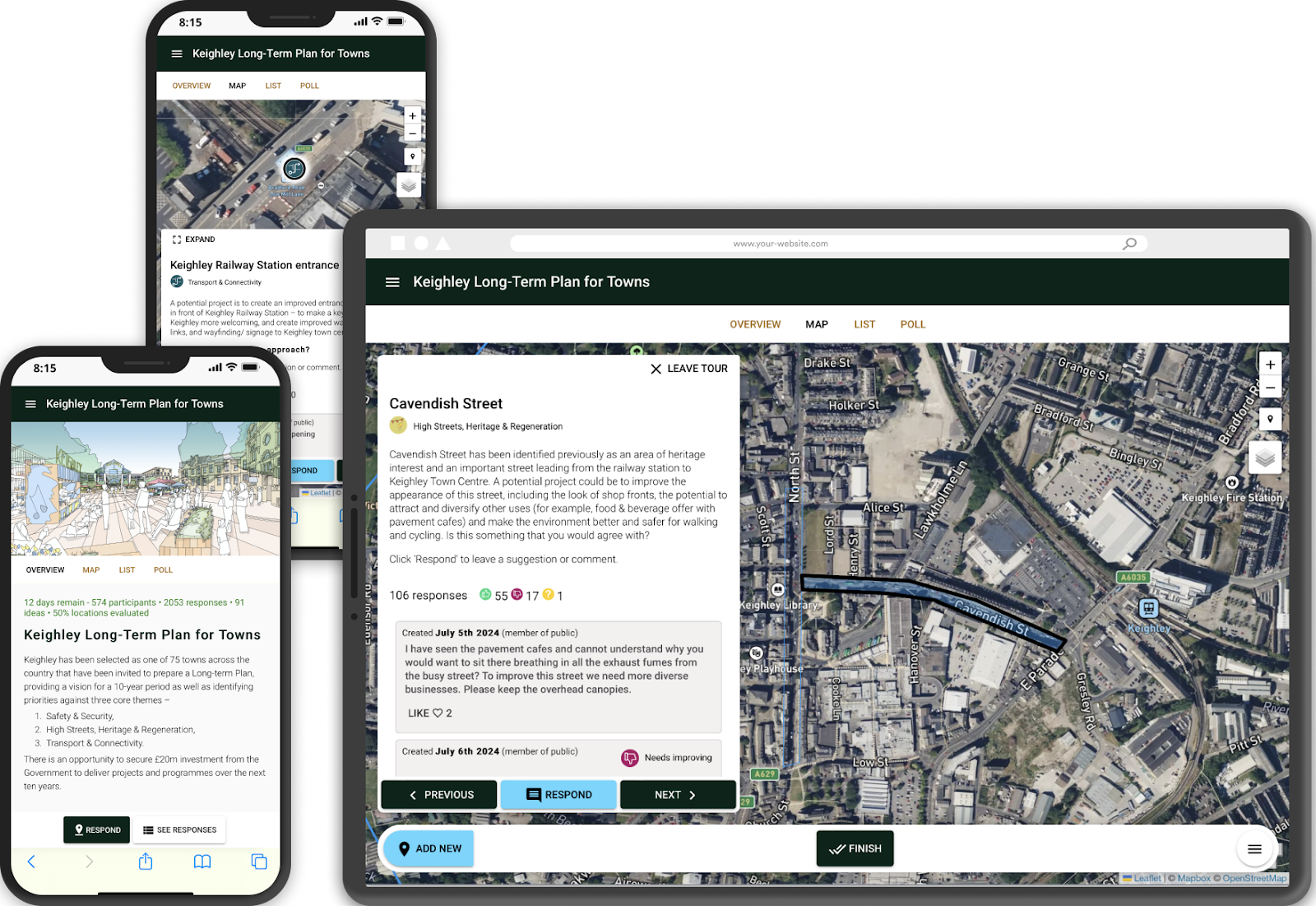
Faced with a tight timeline, Bradford Council and CBRE turned to PlaceChangers to run a two-week online consultation for Keighley's regeneration vision. The platform enabled 573 participants to generate over 2,000 comments and 90 new ideas. Interactive tools, such as spatial mapping and project tours, facilitated fast and meaningful engagement. Importantly, the platform’s AI-assisted summarisation distilled feedback into actionable insights, helping the Council refine proposals and uncover new, community-supported ideas. The outcome was a robust, community-vetted long list of projects, significantly strengthening Keighley's future investment case — all achieved quickly, affordably, and with broad public participation.
Move Fast, Be Open to Feedback
From experience supporting local authorities and organisations, tight timelines often pressure project teams to limit consultation to internal and expert stakeholders. However, this approach can significantly undermine project strength.
Our best practice advice is to set up a two-stage engagement process:
- Internal Review First: Rapidly gather and refine potential project ideas with internal teams and stakeholders.
- Public Vetting Immediately After: Publish these early concepts — even if unfinished — for public comment, critique, and idea generation.
This "open critique" method brings several advantages:
- Increases project credibility by demonstrating genuine community involvement.
- Strengthens project design by identifying gaps, blind spots, or opportunities that may have been overlooked internally.
- Generates additional proposals from the community that better meet local needs.
- Speeds up iteration: Fast feedback loops enable you to refine proposals quickly, ensuring your final submission is robust and well-supported.
Ultimately, showing agility and a willingness to adapt to public input is a compelling story for UKSPF assessors — and leads to stronger, more resilient projects.
Use Interactive Digital Tools
Interactive digital platforms can significantly enhance the quality and speed of consultations. Using tools like PlaceChangers enables:
- Easy input by anybody online: Ensuring that all community voices, including those less likely to attend traditional consultation events, are captured.
- Fast knowledge sharing through peer review and prioritisation: Allowing community members and stakeholders to view, comment on, and prioritise ideas in real time, fostering a transparent and dynamic engagement process.
- Quick summaries and shared access for key decision-makers: Providing real-time dashboards and accessible summaries so that those responsible for investment plan preparation can collaborate efficiently and respond rapidly to community feedback.
Harnessing these capabilities ensures that consultation is not only broader and deeper but also more effectively integrated into the fast-paced timelines of UKSPF applications.
Ensure feedback is place-based and context-retaining
A critical success factor is to employ tools that maintain a place-based perspective throughout the consultation process. This can be achieved by conceptual impact baselines, such as Place analytics and interactive consultations, enabled by PlaceChangers. By anchoring proposals and ideas in specific geographies, communities can avoid the risk of generic, unfocused investment plans. Tools like PlaceChangers ensure that:
- Local context and identity are preserved, making projects feel inherently vested in the areas they seek to serve.
- Priorities can be directly mapped to place-based needs, thereby reinforcing the evidence base required for successful funding bids.
- Consultation outputs stay tied to real-world locations, offering a strong, tangible foundation for investment narratives.
Leverage AI-assisted summaries for insight generation
Modern digital consultation tools also benefit from sensitive AI-driven analysis, making it easier and faster to translate large volumes of community input into actionable insights. With PlaceChangers, for example, you can quickly surface:
- Top 3 Practical Suggestions: The most endorsed ideas for improvement.
- Top 3 Critiques: The most common concerns or objections raised.
- Top 3 Key Questions: Areas requiring further clarification or exploration.
This structured insight generation ensures that consultation results are not overwhelming but instead channelled into clear, strategic priorities for investment planning.
Conclusion
As councils and their funding partners navigate the competitive UKSPF landscape, a sophisticated, inclusive approach to community consultation is more critical than ever. By leveraging interactive digital tools, you not only enhance your project's credibility and relevance but also position it for success from the initial funding application through to long-term delivery.
At PlaceChangers, we are proud to support organisations in creating truly participatory projects that reflect the needs and aspirations of the communities they serve, ensuring the spirit of the UKSPF is fully realised.
Run interactive community consultations online
Book a demo or start your free trial today.
Start Free TrialGet new articles in your inbox
Subscribe to get more insights like this delivered to your inbox.
Related Articles

From House Types to Housing Evidence: Making Standard Designs Reusable Across Consultations
Enabling housing evidence and better quality designs from resident-feedback on house types.

Managing community consultation across multiple planning projects
The answer is not to make every consultation identical. It is to create a repeatable delivery model that still leaves room for local context.

RIBA Stages 2 to 4: digital community engagement tools that actually help design teams
What digital engagement tools are actually useful once the design starts to take shape?