



RIBA Stages 2 to 4: digital community engagement tools that actually help design teams
Topics
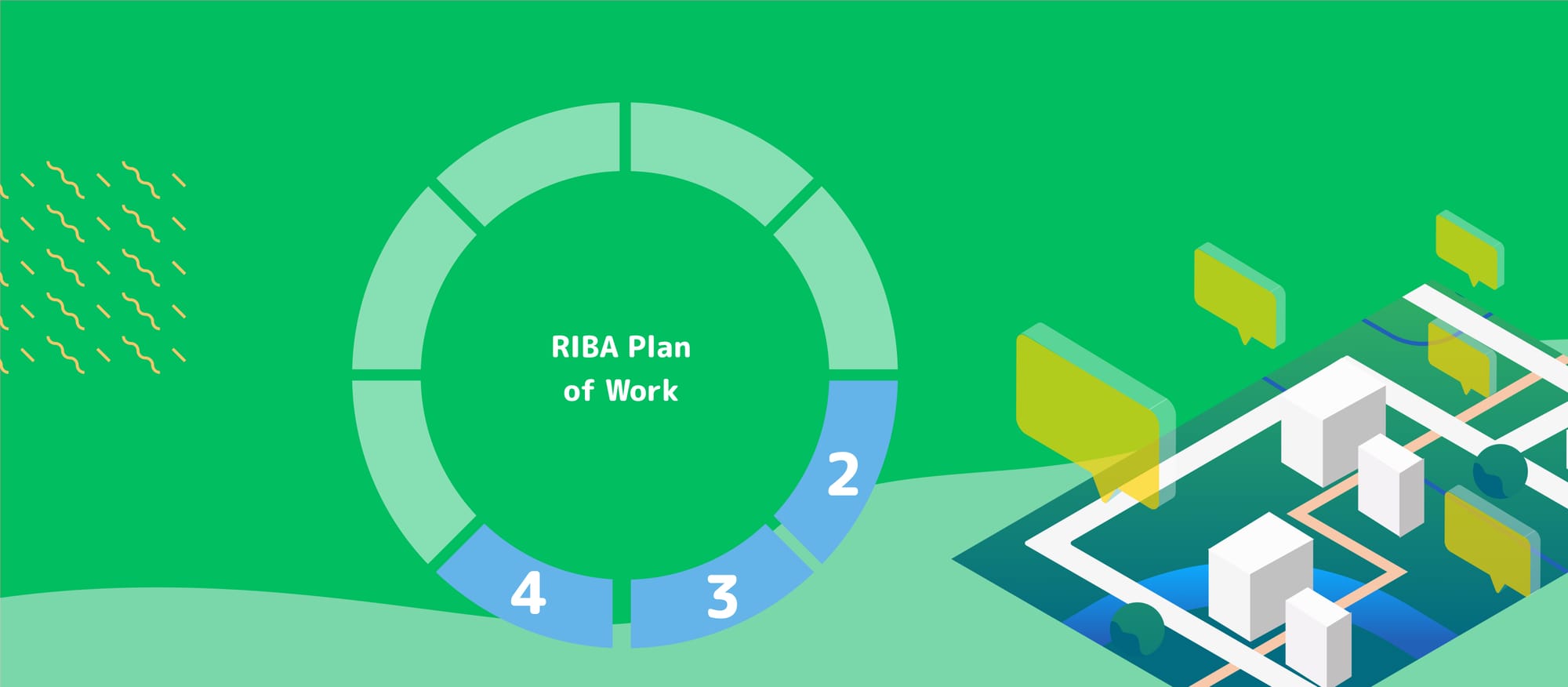
The RIBA Plan of Work gives project teams a shared structure for moving from brief to concept, coordination, technical design and delivery. But the practical question for many architects, planning consultants and development teams is more specific:
What digital engagement tools are actually useful once the design starts to take shape?
The short answer is that good tools should do three things:
- Help people understand the proposal before they respond.
- Capture feedback in a format the project team can actually use.
- Preserve the link between design decisions, community input and reporting evidence.
That sounds simple. In practice, it is where many project teams lose time.
This is where tools like PlaceChangers can help: not by adding another standalone survey or project website, but by helping the team move from public explanation to usable feedback, analysis and reporting evidence in one structured process.
Why Stages 2 to 4 are different
Stages 2 to 4 are not just three labels on a programme. There are different kinds of design risk.
- At Stage 2 (Concept Design), the team is actively shaping the emerging architectural concept. Where community engagement is appropriate, it should help people understand the emerging idea, the site context, the main options and the likely trade-offs.
- At Stage 3 (Spatial Coordination), the team is testing and validating the architectural and engineering information so the proposal is spatially coordinated. For many planning-led projects, this is also the point where the material needed for formal approvals is being assembled, refined or submitted.
- At Stage 4 (Technical Design), the project is moving into technical design. Engagement is usually less about reopening the whole concept and more about keeping a clear, auditable record of what has changed, what has been resolved and what still needs explanation.
This is why a single survey link rarely does the job well. A survey can collect answers, but it does not necessarily explain the design, connect comments to locations, support iteration or make reporting easier.
What a good digital community engagement tool delivers
In practical terms, this means the project team should come away with more than a list of comments.
For PlaceChangers users, the value is that these outputs stay connected. The proposal, map, guided explanation, feedback questions, location-specific comments and exportable records sit within one workflow, rather than being split across a website, PDF boards, survey software and spreadsheets.
That matters because pre-application engagement needs to be proportionate to the nature and scale of the proposal, and expectations can vary by project, planning route and local authority. A connected digital process helps the team show what was presented, what people said, where comments related to the proposal and how the evidence was reviewed. (GOV.UK)
Stage 2: make the concept understandable
Stage 2 engagement is often where digital tools can have the biggest effect. At this point, the proposal is developed enough to discuss, but not so fixed that every piece of feedback feels like a late objection.
The most useful tools at Stage 2 are the ones that help people understand the proposal in context:
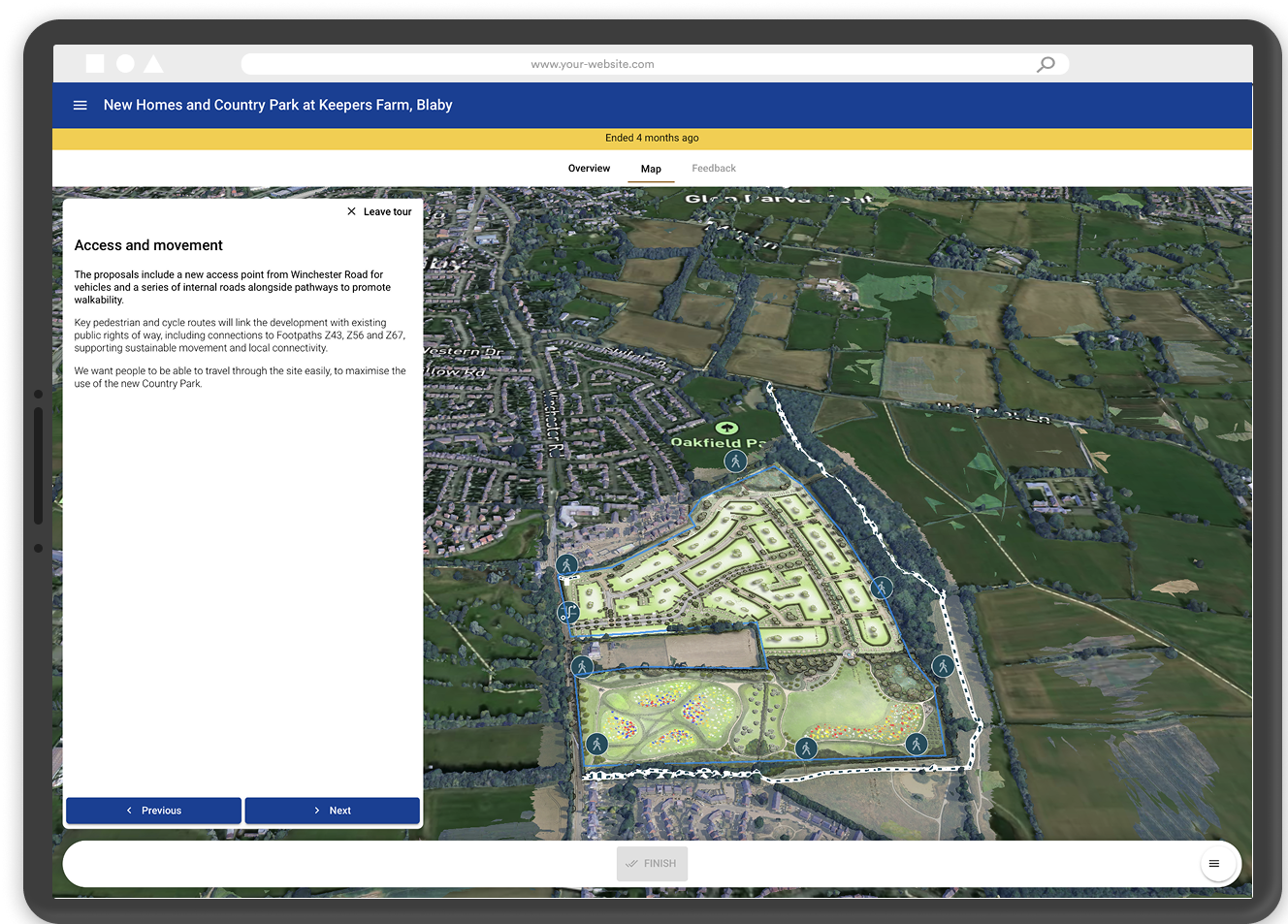
- Interactive proposal maps that show what is proposed, where change happens and how the site relates to the surrounding neighbourhood.
- Guided consultation tours that walk people through the story of the project before asking for feedback.
- Image, plan, 3D or Street View prompts that make scale, movement, access, public realm and key views easier to understand.
- Structured feedback journeys that ask different questions at the right moment, instead of dropping everyone into one long form.
This matters because many consultation responses are shaped by comprehension. If residents are asked to respond to a static board, a long PDF or a technical drawing without enough context, the project team often receives comments that are broad, anxious or difficult to action.
Better Stage 2 engagement is not about making the proposal look polished too early. It is about making the concept legible enough that people can respond to the parts the team can still shape.
A useful Stage 2 digital setup should answer questions like:
- Can people understand the site boundary, access points and nearby constraints?
- Can they see the relationship between proposed homes, open space, routes, parking, servicing or public realm?
- Can they comment on specific places or themes, rather than only submitting a general response?
- Can the team distinguish between design feedback, planning concerns and comments about wider local issues?
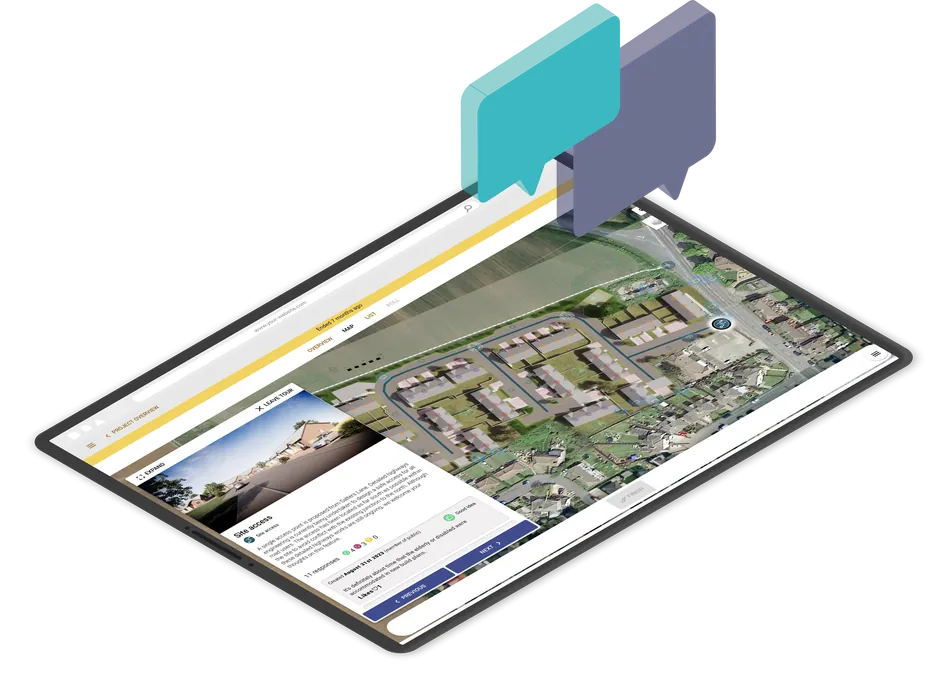
For PlaceChangers users, this is where Interactive Proposal Maps and Guided Consultation Tours are usually most valuable. The team can present the site boundary, key locations, movement routes, open space, access points, images, plans, 3D views or explanatory prompts in one guided public view. Instead of asking people to read a PDF and then complete a detached survey, feedback can be requested at the point where the respondent is reviewing the relevant part of the proposal.
Stage 3: connect feedback to coordination
By Stage 3, the question changes. The design team is no longer simply asking, "What do people think?" The team needs to understand how feedback relates to a spatially coordinated proposal.
This is where disconnected tools become expensive.
If the website is in one system, the survey is in another, the proposal map is a PDF, and comments are analysed in a spreadsheet, the team has to rebuild the evidence trail manually. That is slow, and it increases the risk that useful feedback is reduced to a few anecdotal quotes.
The most useful Stage 3 tools are those that keep the evidence connected:
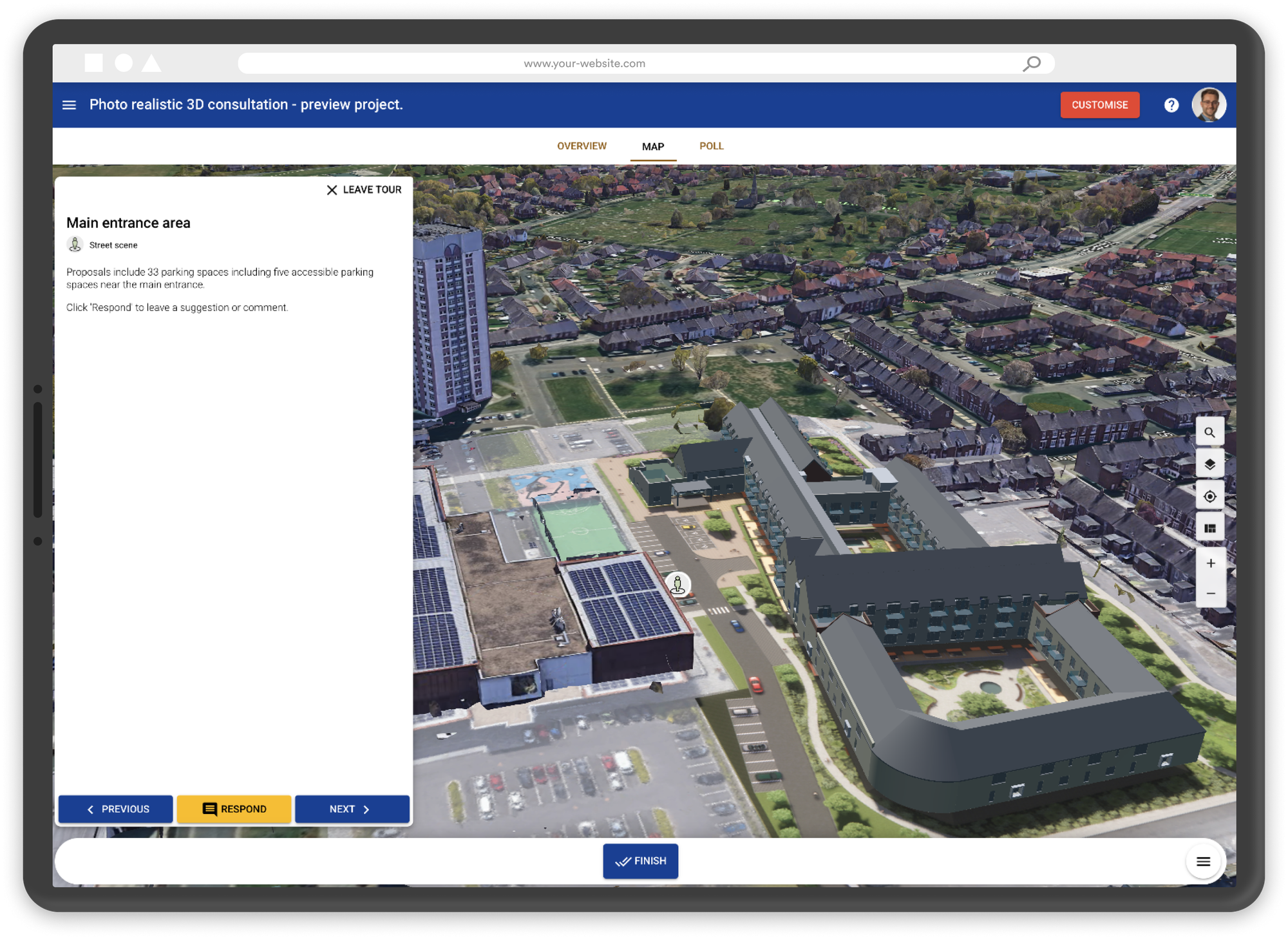
- Location-specific comments tied to a proposal map or consultation area.
- Survey questions linked to specific design topics, such as access, open space, overlooking, movement, landscape, active travel or community facilities.
- Response filters that separate residents, local organisations, statutory stakeholders, interest groups and other audiences where appropriate.
- Tags and themes that help the team review repeated issues without losing the underlying comments.
- Exportable records for design review, client reporting, planning statements and consultation reports.
The output does not need to be a glossy report on day one. It does need to be structured enough that the team can see what was said, where it applies and what action was taken.
For many projects, Stage 3 is also when planning strategy, design and engagement evidence begin to converge. GOV.UK planning guidance is clear that local planning authorities run formal public consultation after an application is received, and local authorities may set out more detail in their Statement of Community Involvement. For applicant-led or pre-application engagement, the exact expectations depend on the project, local policy, the planning route and the authority. So the safest digital approach is not to claim that engagement is always legally required. It is to keep a proportionate, transparent record where engagement is being used to support better design and clearer planning evidence.
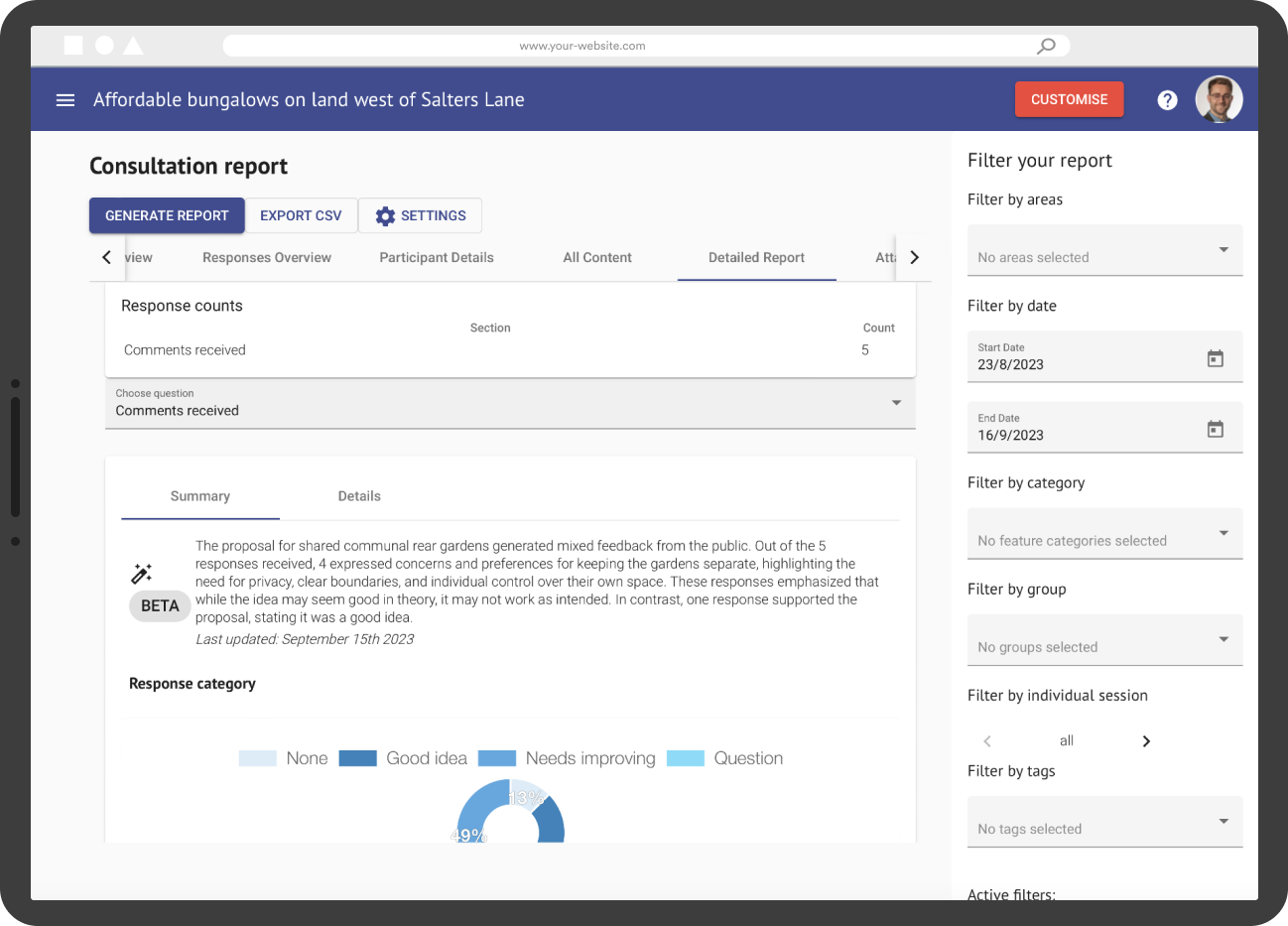
PlaceChangers supports this through Structured Community Feedback, response filters, map-based comments and export-ready records. The practical value is that the team can move from “we received 200 comments” to “these are the issues raised about access, landscape, overlooking, traffic, open space and local facilities; this is where they relate to the proposal; and this is how the project team reviewed them.”
Stage 4: keep the evidence clear
Stage 4 is sometimes treated as outside the engagement conversation. That can be true for many projects: technical design and finalisation is not usually the moment to restart engagement.
Stage 4 can still create stakeholder and reporting needs. For large projects, design amendments may need explanation. Client, member or internal governance teams may need to go back to review feedback received at the consultation stage. On complex projects, late technical changes can also raise questions about whether the proposal still reflects what was previously shown.
The goal is not more engagement for its own sake. It is continuity. If the project team has to reconstruct the story from emails, screenshots and spreadsheet tabs, the value of earlier engagement is partly lost.
PlaceChangers helps preserve that continuity by keeping the consultation material, mapped responses, structured answers, exports and analysis together. At Stage 4, that can support internal reviews, planning responses, design amendment notes, committee preparation or client reporting where the team needs to explain what was previously shown and how the proposal has evolved.
What usually fails
Most teams do not fail because they choose one bad tool. They struggle because the toolset is fragmented.
Common patterns include:
- A project website that looks professional, but does not connect to the feedback data.
- A survey tool that collects responses, but cannot show where comments relate to the proposal.
- A PDF exhibition board that explains the scheme, but gives people no useful way to respond in context.
- A GIS map that is powerful for the technical team, but too complex for many public participants.
- A spreadsheet that becomes the real evidence base, even though it was never designed for audit, filtering or reporting.
None of these tools are wrong in isolation. The problem is that RIBA Stages 2 to 4 need continuity. The proposal, the feedback, the analysis and the reporting need to stay connected.
A practical digital engagement stack
For most Stage 2 to 4 planning and design projects, the strongest setup is not a large enterprise engagement suite. It is a focused workflow that helps the team explain the proposal, collect useful feedback and preserve the evidence trail.
- First, a public-facing consultation page. This should explain the project clearly, use the right branding and give people one reliable place to find information.
- Second, an interactive proposal map or visual journey. People should be able to understand where change is happening, how the proposal relates to the surrounding area and why the design team is asking for feedback.
- Third, structured feedback. The questions should match the decisions the team can still influence, rather than asking broad questions that produce hard-to-use responses.
- Fourth, evidence management. Responses should be filterable by question, theme, location and stakeholder type, with exports for design review, client reporting and planning evidence.
- Fifth, reporting. The team should be able to move from raw responses to summaries, charts, mapped evidence and decision notes without restarting the analysis in a separate spreadsheet.
The test for digital engagement is not whether the project had a website, a survey or a map. The test is whether the team can clearly evidence what was shown, what people said, where comments related to the proposal and how the evidence informed the next stage of work.
That is where digital tools can make a real difference across RIBA Stages 2 to 4. Used well, they reduce manual reporting, make feedback easier to interpret and give the project team a clearer evidence trail from concept design through spatial coordination and technical design.
PlaceChangers supports that process by keeping the proposal, consultation journey, mapped feedback, structured responses and exportable evidence connected from the start.
Run interactive community consultations online
Book a demo or start your free trial today.
Start Free TrialGet new articles in your inbox
Subscribe to get more insights like this delivered to your inbox.
Related Articles
Managing community consultation across multiple planning projects
The answer is not to make every consultation identical. It is to create a repeatable delivery model that still leaves room for local context.
Site Visits in Town Planning and Design: What Project Teams Look For and Why It Matters
Learn why site visits matter in planning and design, what project teams look for on site, and how site-based evidence supports planning applications, design decisions and stakeholder engagement.
From Plan to Proof: How to Simplify Consultation Outreach and Response Tracking
Learn how planning teams can plan consultation outreach, invite the right households, and keep a clear record of responses, materials and follow-up actions with PlaceChangers.