





New house building: Aspects that raise community support
Topics
Large development projects capture the attention of the community. What can you do to help build community support for a development project?
While the formal community consultation conducted by councils typically asks respondents to either 'support' or 'object,' your pre-application resident consultation allows for a more open and focused discussion on the design aspects to help build community support for a development project.
In this article, we will explore how an engagement process can effectively identify and address local concerns, convey and enhance the value added by your planning project, and ultimately secure more support.
Let's be honest: most planning proposals will face degrees of opposition. Therefore, presenting the benefits and ascertaining whether these views align with the community's perspective is crucial. Even when there is disagreement regarding the benefits, negative feedback also holds value: It aids in understanding local concerns and pinpointing improvement opportunities that can garner support.
Who supports new housing development?
Who supports development in their area? Let's look at the facts. Surveys show that residents are not uniformly opposed to new planning projects or housing developments.
A study by market research agency YouGov and Shelter on the ‘silent majority’ established that 69% of respondents were positive or neutral about house building in their area. Even across age groups, supporters tended to outnumber opponents by 5 to 3, subverting the common notion that the community immediately views new development negatively.
Based on a 2023 survey, Ben Marshall of Ipsos UK noted, "Support for new home building is very conditional on location". Generally, they found that 70% of respondents either supported or strongly supported development on land formally built on. On the other hand, only 24% of respondents strongly supported or supported development on 'Greenfield' land.
Which factors help build community support for a development project?
Most people tend to be either supportive or remain neutral towards development. However, support tends to be significantly lower in out-of-town areas. In places where scepticism towards development runs high, community engagement becomes crucial.
Research conducted by YouGov and Shelter highlights the importance of identifying elements in your development proposal that resonate with residents. While there are no one-size-fits-all solutions, understanding concerns and proactively underscoring the project's benefits can significantly impact support.
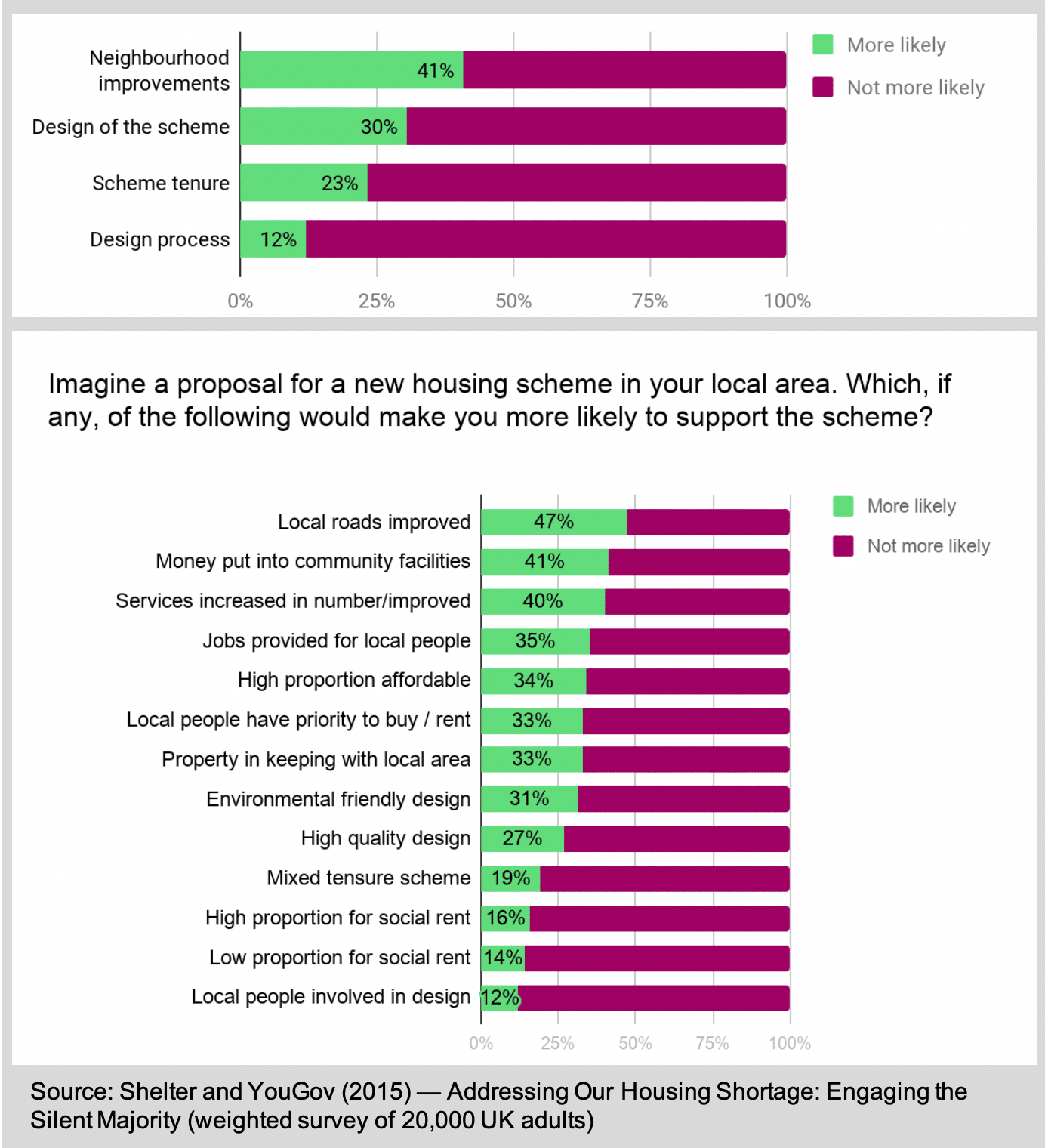
The YouGov study involved participants envisioning a new housing project in their area and selecting scenarios that would make them more inclined to support it. These scenarios can be grouped into four main categories:
1) neighbourhood improvements, 2) the architectural design, 3) aspects relating to proposed tenures, and 4) the inclusiveness of the design process (see below).
<img alt width="1384" height="1520" title="stats" data-id="1168" src="https://test-site.placechangers.co.uk/content/images/2025/07/stats-1.png" style="width: 100%;">
What does this mean for communicating benefits in planning consultations?
By considering the positive local impacts in those four areas from the Shelter and YouGov study, you can increase support for a planning project or planning application:
Neighbourhood improvements (41% more likely to support)
New development projects can significantly benefit an area by enhancing local infrastructure, services, and the well-being of residents. Even minor improvements like fencing can matter. Besides direct financial contributions, consider safeguarding local services like post offices and banks and creating job opportunities.
Design of the project (30% more likely to support)
This pertains to the experience of your development for both residents and visitors. High-quality construction, attractive public spaces, and seamless integration with the existing neighbourhood are crucial for garnering support. Embracing environmentally friendly designs is a growing trend, focusing on access routes, green spaces, and enhancing the public realm.
Project tenure (23% more likely to support)
Incorporating affordable or social housing for locals increases the likelihood of project support. Communities typically favour mixed-use developments that offer suitable living spaces, especially for young families.
Inclusivity of the design process (12% more likely to support)
This can be crucial in gaining project support, especially if the site is inhabited. While it may not always guarantee support, it can sway decisions, especially for larger projects with social contributions like urban estate regeneration. It's generally advised to engage early and demonstrate an appreciation for valid concerns raised by residents.
Takeaways for building community support for a development project
Think about the selling points of your proposal. Be sure to present those selling points in your planning consultation and gather responses on each. In order to do so, research the site context and speak to local people.
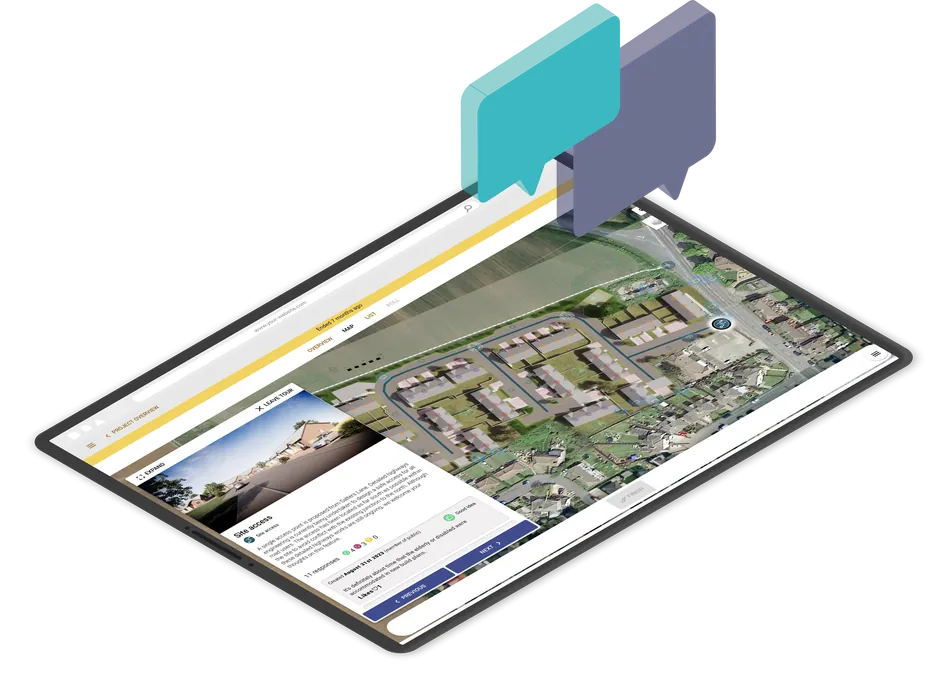
Consider tools and more meaningful engagement formats. For instance, the PlaceChangers interactive planning consultation tool enables easy-to-use, design-focused consultations which enable direct engagement with the design. This ensures that the community consultation is engaging and productive, and less focused on for and against a development.
Embrace feedback as a valuable source of insight. Develop an engagement approach that can capture the voices of relevant audiences beyond the immediate vicinity on the ideal value add of your scheme.
Run interactive community consultations online
Book a demo or start your free trial today.
Start Free TrialGet new articles in your inbox
Subscribe to get more insights like this delivered to your inbox.
Related Articles

Site Visits in Town Planning and Design: What Project Teams Look For and Why It Matters
Learn why site visits matter in planning and design, what project teams look for on site, and how site-based evidence supports planning applications, design decisions and stakeholder engagement.

From Plan to Proof: How to Simplify Consultation Outreach and Response Tracking
Learn how planning teams can plan consultation outreach, invite the right households, and keep a clear record of responses, materials and follow-up actions with PlaceChangers.
How to Turn Public Consultation Feedback Into Clearer Reports for Stakeholders
Stop manual spreadsheet data entry. Learn how AI-driven urban planning software turns messy public consultation feedback into professional, stakeholder-ready reports for the built environment in minutes.