





Planning for Consent: Why Design-Led Engagement is the Developer’s Best De-Risking Strategy
Topics
In the high-stakes run-up to a planning application, the traditional developer’s playbook has typically relied on good old public relations and "communication messaging". From a planning consultation standpoint, the goal is often to find the "silent majority," frame the benefits in glowing terms, and retain design details behind a curtain until the last possible moment.
But as many public consultations face a gap in trust, this "messaging-first" approach is hitting a wall. Communities are cynical towards developers even if projects have existing benefits, and Planning Committees are becoming sceptical or immune to glossy brochures or outlines of benefits, where the consultation feels like a done deal — and risking of opening a trust gap between applicants and local people.
For developers and house builders aiming for consent, the winning strategy isn't targeted messaging around abstract benefits. It’s design-led engagement with links benefits to the changes on the ground.
The Trap of the "Messaging-Only" Model
Old school consultation models often focus on talking points, static display boards, and abstract outcomes over clear benefits, visual clear narratives, and outcomes mapped to project designs.
Messaging online models work on the basis that little awareness of designs raises fewer objections or opportunities to nitpick. However, it’s exactly that ambiguity which creates a trust vacuum to immediate residents, who are the most likely to get engaged. When you lead with benefits but hide the substance, projects often validate the community's fear that:
- The decision is opaque: Outcomes feel negotiated behind closed doors.
- The consultation is performative: A procedural hoop rather than a genuine opportunity to shape the site.
In this environment, even the most "pro-growth" messaging can feel like spin, with questions around how these benefits are practically materialised. We all get it, change is hard. For nearby residents, not all benefits will outweigh concerns around parking, changed open space, or access to social infrastructure provision.
Reach is Not Evidence: The Facebook Ad Fallacy
Similarly, there has been a worrying rise in objection spam, often with many duplicate and similar concepts or reasons to resist change, occasionally with lack of founding in actual project details, which stems from the issue above.
On the flip side, we have seen a rise in "reach-based" solutions—using Facebook ads to reach the silent majority who "Likes" projects. It is not uncommon to see 1000s of views vs a tiny number of respondents, e.g. 25,000 vs 50 respondents to surveys done that way. However, here developers cannot expect much substantive feedback beyond generic comments or preferences.
While reaching the "silent majority" is crucial, most planning officers and committee members increasingly understand that volume is not the same as validity. In the same way that objection spam, will make volume of objections less important, a Planning Committee is unlikely to be swayed by a report stating that 500 people clicked a "Support" button on a social ad if those people haven't actually engaged with the spatial reality of the scheme.
To win at committee, you need a defensible audit trail with practical insights from people who actually care. The best case is for you to show how neighbours didn't just "support a project"—they understood the trade-offs and at least acknowledged benefits, albeit outright support on changes will often be received with challenge. Who likes change?
The Alternative: Design-Led Consultations
Messaging and wide outreach clearly have a place in community consultation, as they are a key way to reach audiences. Outreach is most effective if the response options are tied back to practical changes on the ground. Design-led engagement is one of the most powerful ways to replaces "vudo" with transparency, and authenticity. By using interactive 3D/2D mapping and real-world data (like walkability scores or "Ped-Sheds") early in the process, you change the dynamic from a battlefield to a partnership.
Planning for Consent is enhanced through a number of key activities
1. Do Good Planning: The Power of Local Context
Before the first brochure is printed, the most effective de-risking strategy is simply doing good planning" and picking up on local context. This means starting with a deep dive into context analysis and an early review of local needs, such as place analysis techniques and tools. When your proposal is rooted in local facts rather than developer assumptions, you don't need "planning speak" to justify it. You can lead with benefit-oriented communications that feel authentic because they solve a pre-identified local problem—whether that’s a lack of connectivity, poor access to green space, or missing social infrastructure.
2. Mobilise the "Silent Majority" with Facts, Not Fluff
Instead of a brochure telling people "it’s a green development," show them a spatial map of the new public realm with interactive aspects and opportunities to take a personalised tour through a new development. When a resident can see exactly how a new path connects their street to a local amenity, their support moves from "abstract" to "active".
3. Move from "Objection Management" to "Value Alignment"
Our data shows that developers often worry about the volume of pushback. People are looking for ways to block projects because they feel powerless. By using your designs and layouts as conversation tool early on, you can easily categorise feedback into actionable design data. You aren't "fighting" objectors; you are using their specific feedback to prove to the council that you have listened, acknowledged their points, and, where appropriate, adapted the scheme to meet local requirements.
4. Build a Bulletproof "Statement of Community Involvement" (SCI)
The final hurdle is often the reporting. An automated digital audit trail that shows how people interacted with your site designs is infinitely more powerful than a summary of a village hall meeting. PlaceChangers enables you to generate a Statement of Community Involvement that is robust, transparent, and evidence-led. It provides the "Substance" that planners and committees need to justify a "Yes" even in the face of vocal objections.
The Bottom Line: Trust is Your Greatest Asset
The UK doesn't just have a housing delivery problem; it has a legitimacy problem. People are often willing to accept change if they believe the process is honest, fair, and genuinely open, and if they can trust that the school, GP, or shop that’s been promised with their big new development can materialise and where. Or that their worries around boundary treatments, open space, and street infrastructure implementations were considered.
For the modern developer, transparency isn't a risk—it's a shield. By leading with the substance of your project and providing a platform for genuine spatial feedback, you don't just "manage" the community. You earn the consent you need to build.
Want to see how PlaceChangers interactive consultations support planning approvals?
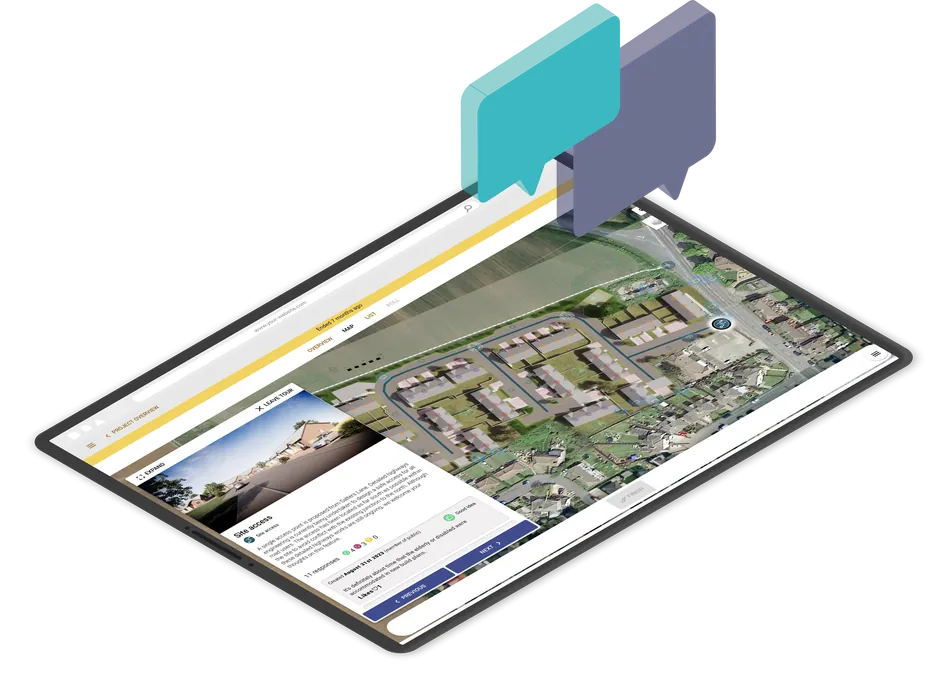
Run interactive community consultations online
Book a demo or start your free trial today.
Start Free TrialGet new articles in your inbox
Subscribe to get more insights like this delivered to your inbox.
Related Articles
Site Visits in Town Planning and Design: What Project Teams Look For and Why It Matters
Learn why site visits matter in planning and design, what project teams look for on site, and how site-based evidence supports planning applications, design decisions and stakeholder engagement.
From Plan to Proof: How to Simplify Consultation Outreach and Response Tracking
Learn how planning teams can plan consultation outreach, invite the right households, and keep a clear record of responses, materials and follow-up actions with PlaceChangers.
How to Turn Public Consultation Feedback Into Clearer Reports for Stakeholders
Stop manual spreadsheet data entry. Learn how AI-driven urban planning software turns messy public consultation feedback into professional, stakeholder-ready reports for the built environment in minutes.