





From House Types to Housing Evidence: Making Standard Designs Reusable Across Consultations
Enabling housing evidence and better quality designs from resident-feedback on house types.
4 min read
Get the latest insights in this topic delivered to your inbox.
22 articles in Planning Consultations
Enabling housing evidence and better quality designs from resident-feedback on house types.

The answer is not to make every consultation identical. It is to create a repeatable delivery model that still leaves room for local context.
Make your interactive consultation truly yours. PlaceChangers provides a seamless, "on-brand" setting including custom domains, logos, and interactive site tours, and more.

Secure planning consent through substance-led engagement—the best de-risking strategy for the modern developer.
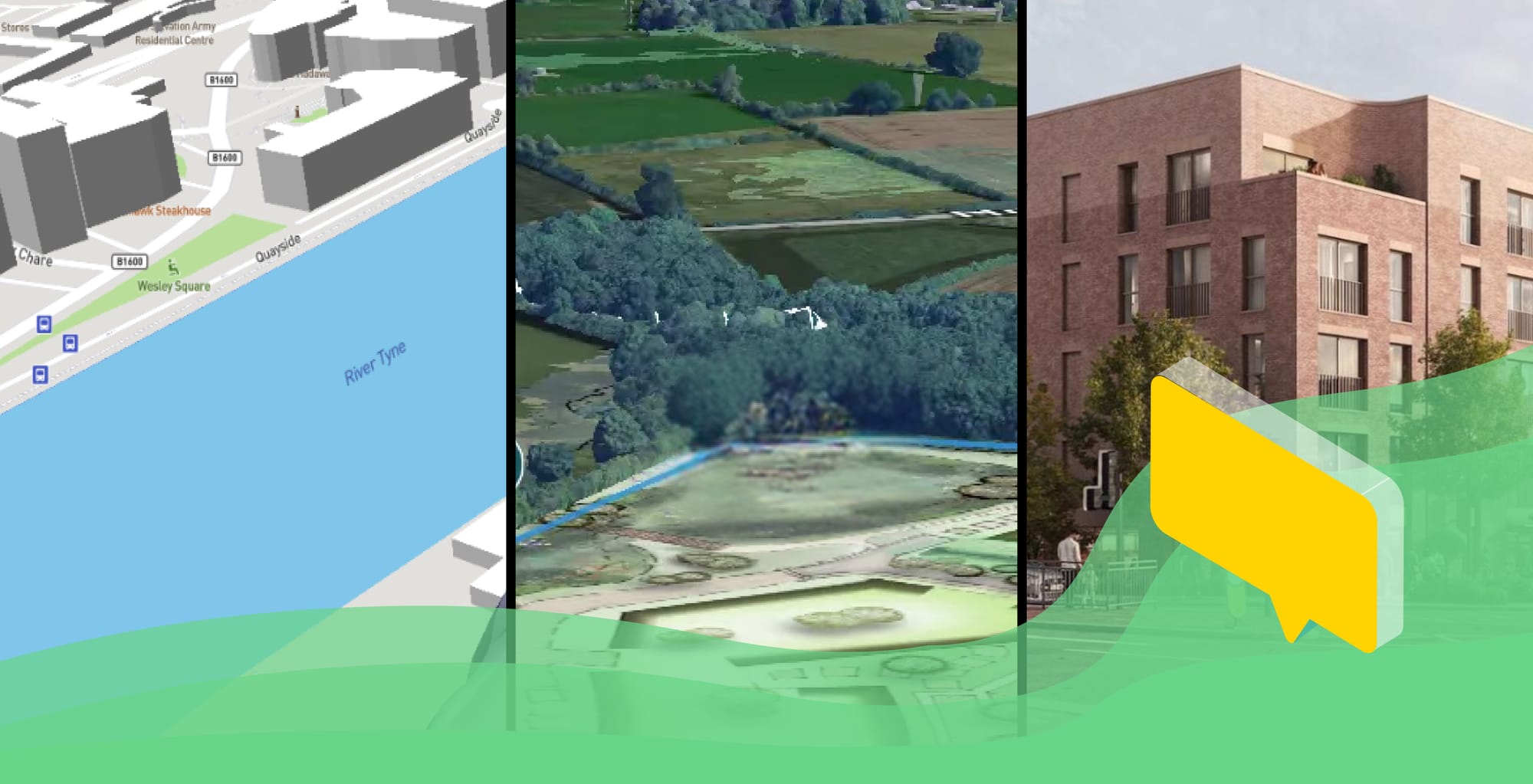
Learn about visualisation for public consultation in planning and different the approaches available to you.
On Monday morning, a local Facebook group celebrated a milestone: more than five thousand online objections logged to local council’s planning portal against a single scheme. Online systems such as object.now specialise in facilitating objections, and one can easily predict how AI comes to play here in producing content “in just a few clicks”. The graph looked impressive; the evidence less so. Anyone who has worked on a live case knows the pattern—near‑identical letters, sweeping legal claims, a

When it comes to planning consultations, we often hear the same question: “Why use a platform when I already have a website?” On the surface, a project website—built in WordPress or a similar platform—might seem like enough. However, upon closer examination, key differences become apparent in speed, ability to visualise proposals to the public, engagement levels, and the quality of feedback that can be gathered. In this article, we’ll compare DIY websites with purpose-built engagement platform

Community engagement is crucial for urban planning, aligning projects with residents' needs. Let's take a brief look at public exhibitions and online community consultations as two contrasting but complementary methods. Traditional methods, such as in-person public exhibitions with display boards in a village hall, have been the staple of public participation for years. However, a new generation of online community consultation platforms and tools like PlaceChangers interactive consultation to
Introduction Post-Occupancy Evaluation (POE) is a powerful tool used to assess how well a building or urban development meets its design goals, focusing on user satisfaction, functionality, energy performance, and social outcomes. For large housing estates, POE plays a crucial role in refining urban design to better align with residents' needs and preferences. Unlike individual buildings, Post-Occupancy Evaluation for residential and mixed use projects must address the complexity of entire nei
At PlaceChangers, we recognise the transformative power of community consultation in shaping successful housing developments and regeneration projects. It’s often said that higher levels of engagement lead to project success by greater ability to meet local needs, which in turn supports future customer satisfaction and sales success. Through this article, we explore how early community involvement can be a pivotal factor in the ultimate success of housebuilders, highlighting our commitment to c

Introduction The Pre-Application Community Consultation Process is an activity where developers engage with the local community before applying for planning permission, particularly for major developments. This interaction allows developers to gather views and opinions about the project, which they can consider before submitting their planning application. It's now mandatory for developers to conduct this consultation for most major developments. It's important to note that pre-application cons
In town planning, the link between community consultation and effective communication cannot be overstated. As urban landscapes evolve, involving the community in decision-making processes becomes integral to creating sustainable and inclusive developments. How this is done can be set out in communications plans. This article gives an overview of the importance of a communication plan to support engagement during town planning initiatives. PlaceChangers platform is often used to support interac

Artificial intelligence in town planning can be hugely transformative. Here, the PlaceChangers team looks at some of the key areas of focus in the coming years. There is tremendous hype around artificial intelligence (AI). It has gone from zero to Existential threat in less than 12 months. You may have seen the evil sentient AI in Mission: Impossible or read that AI is a flashpoint in the recent strike of Hollywood actors. While entertainment is where we allow the blurring of fact and fiction,

Consultation and engagement with residents are vital to making planning and construction projects more responsive to local needs and concerns. Ideally, every planner would engage with residents affected by plans at the earliest opportunity possible. In reality, planners can be hesitant. They might feel anxious about opening a project up to the public as any changes to plans are constrained by the business case and design direction. At PlaceChangers, we often ask what makes a consultation succes
It is the unfortunately truth that not all planning applications receive a warm welcome. In fact, receiving some degree of objection can be considered the general norm. Between October and December 2021, according to UK government statistics, 13% of planning applications made to local councils in England were either refused or pulled. When planning applications are refused, it often indicates a breakdown in productive conversations with external project stakeholders, including residents and the
Let's look at a few key planning consultation trends in 2022. The last two years have reinforced the importance of human connection and how our community contributes to our physical and mental health and wellbeing. This, combined with the lockdowns and isolation, has led organisations to look for better ways to connect online. In 2022 we can see increased efforts to grow the effectiveness and efficiencies of using digital tools for community engagement consultations. Rebuilding trust in insti
In the intricate landscape of urban development and construction projects in the UK, the significance of well-informed decision-making cannot be emphasized enough. The early phases of any development pursuit lay the groundwork for its triumph, yet a recurring hurdle often emerges in the form of prolonged processing times for pre-application advice from local councils. Termed as "pre-app advice" or "pre-planning advice," this indispensable resource acts as a guiding beacon for architects, develop

The Covid-19 crisis of 2020/21 and the subsequent lockdowns had a profound impact on town planning, necessitating swift adaptation to new ways of working and interacting. Town planning consultations with residents and external stakeholders were particularly affected, leading to a significant shift towards online community engagement. For the architecture and planning sector, some of the changes implemented during this period are likely to become long-term fixtures. Notably, there has been a sur

Large development projects capture the attention of the community. What can you do to help build community support for a development project? While the formal community consultation conducted by councils typically asks respondents to either 'support' or 'object,' your pre-application resident consultation allows for a more open and focused discussion on the design aspects to help build community support for a development project. 💡All countries of the United Kingdom now require resident engag

Typically, in construction and planning, public exhibitions in village halls used to be the default form of engagement. In recent years, this method of engagement has been accompanied by approaches that account for our connected lifestyles, using web platforms such as the PlaceChangers engagement platform. Especially during the Covid pandemic, when public events were impossible to arrange, online consultation methods took centre stage. Each method of consultation, online and face-to-face, has d
For many years, UK planning laws have explicitly emphasised the importance of early community engagement. For most significant projects, public consultation requirements now mandate that developers submit a Statements of Community Involvement as part of their planning application. The decisions on formats and levels of community consultation will depend on the project's significance and locality. Recent changes in UK planning policy and law emphasize the need for developers to engage with key s

When planning a development scheme, the temptation for developers to skip, accelerate or water down up-front engagement can be hard to resist. This can result in a vast number of poor design decisions becoming set in stone early on with little potential for change later on. Making decisions without stakeholder involvement will generate immediate resistance to your project, regardless of its merits or benefit locally. For a great example of how not to do things, look no further than Lambeth Coun